I believe in creating timepieces that are truly unique — watches that stand out in a world saturated with mass production. I began this journey as a reaction to the enormous markups on factory-made movements in the market. Every watch I build is a quiet protest, a revival of the lost art of traditional, artisanal watchmaking.
Each movement is hand-finished by me, in my workshop, with over 150 hours of labor poured into every detail. Blood, sweat, and tears go into each piece. My finishing techniques are entirely self-taught — the result of countless hours of research, experimentation, and relentless trial-and-error.
These watches are more than just instruments of time. They're a testament to dedication, individuality, and a refusal to compromise on craftsmanship.
SNAILING
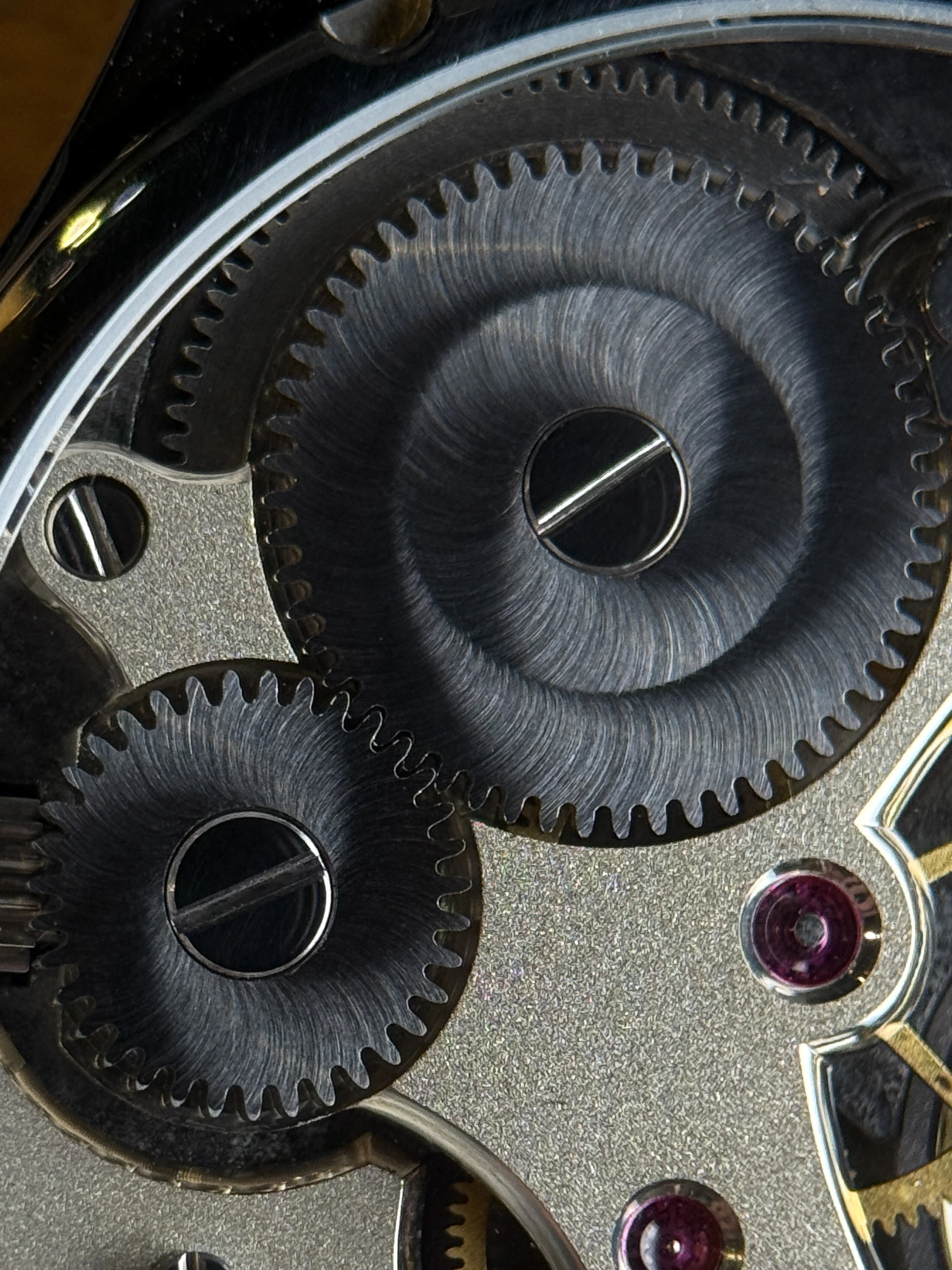
Snailing is a traditional decoration primarily applied to the ratchet and crown wheels of a movement. This technique has been found on watch movements dating as far back as the 1800s, and today it exists almost exclusively in the work of high horology brands and independent watchmakers who continue to practice traditional finishing methods.
The concept itself is straightforward — the workpiece rotates in one direction while a circular grinding head spins in the opposite — but achieving a beautiful result requires getting a number of factors just right. These include the offset angle of the grinding head, its material, the grit of the abrasive paste, and the rotation speeds of both parts on the lathe.
The snailing on my timepieces is done manually on a lathe, with every aspect of the process controlled by hand. The quality you see today is the result of years of research, experimentation, and refinement — all developed through hands-on experience at the bench.
MOSAIC
Mosaic is a decorative technique inspired by traditional methods like scraping (grattage) and charbonnage. It involves using homemade cabrons — abrasive paper mounted on wooden sticks — to create brushstroke-like patterns across a flat surface.
This technique demands intense concentration and a strong sense of artistic judgment. Each stroke must be placed carefully, with adjacent strokes intentionally facing different directions to create a dynamic, textured surface. The goal is to achieve a balanced, visually pleasing composition where no two neighbouring strokes reflect light in the same way.
The end result is a surface that shifts and sparkles depending on how the light hits it, revealing a patchwork of luminous textures. This effect is what inspired the name mosaic, a term I coined for this technique to reflect its intricate, light-catching character.
CONTACT US
Have any questions or inquiries? We would love to hear from you.